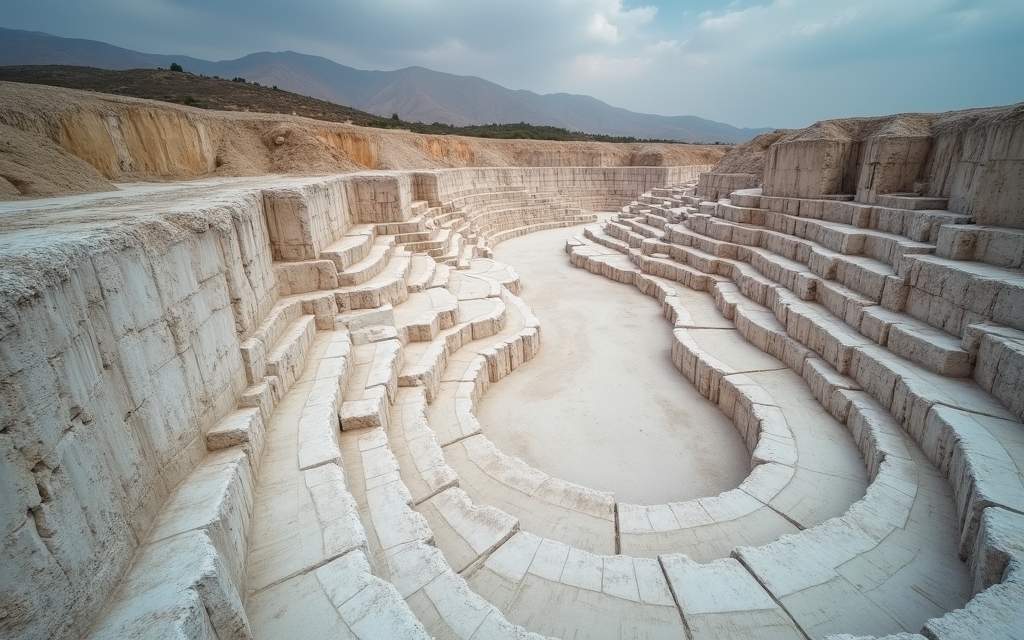
From Mountain to Masterpiece: The Turkish Stone Journey
Turkiye sits atop one of the richest geological formations on Earth. The collision of tectonic plates over millions of years created vast deposits of marble, travertine, limestone, and onyx. Today, Turkiye produces more natural stone than any other country, and the journey from quarry to your project is a remarkable process combining ancient tradition with modern technology.
Quarrying Methods
Diamond Wire Cutting
The most common method in Turkish marble quarries uses a thin steel cable embedded with diamond segments. This wire loops through drill holes in the mountain and cuts through stone with incredible precision. A single wire cut can extract blocks measuring 6 x 3 x 2 meters, weighing up to 30 tons.
Chain Saw Extraction
For softer stones like travertine and limestone, massive chain saws mounted on tracks carve directly into the quarry face. This method produces less waste and allows for more controlled block shapes. The Antalya and Denizli regions are famous for their travertine quarries using this technique.
Bench Quarrying
Large open-pit quarries use a bench system, extracting stone in stepped terraces. Each bench is typically 6-12 meters high. Heavy machinery including front loaders and excavators move the cut blocks to the processing area. This method is common in the Mugla white marble quarries.
Block Selection and Grading
Not every block makes the cut. At Atlasia Trading, we inspect each block for:
- Color consistency — uniform tone without unexpected color shifts
- Structural integrity — no micro-fractures or hidden cracks
- Pattern quality — veining that meets the expected aesthetic standard
- Volume yield — estimated slab output vs. waste ratio
Blocks are graded as First Choice (premium), Commercial, or Budget grade. Only First Choice material ships to our clients.
Processing: From Block to Slab
Gang Saw Cutting
Massive gang saws with multiple parallel blades slice each block into slabs. A typical block yields 40-60 slabs of 2cm thickness. The process takes 6-12 hours per block depending on stone hardness.
Resin Treatment
Many stones receive a resin treatment to fill natural micro-fissures and strengthen the slab. This is standard industry practice and ensures the stone performs well in its final application. Epoxy or polyester resin is applied under vacuum pressure for complete penetration.
Polishing and Finishing
Automated polishing lines use progressively finer abrasive heads to achieve the desired finish. Polished finishes use up to 14 polishing stages. Honed finishes stop at a lower grit for a matte appearance. Brushed and tumbled finishes use specialized equipment for textured surfaces.
Quality Control and Export
Every slab is inspected before shipping. Quality checks include thickness consistency, surface defects, color matching between slabs, and proper crating. Turkish stone is exported to over 150 countries, with strict packaging standards to prevent damage during transit.
At Atlasia Trading, we manage this entire process for you — from block selection at the quarry through processing, quality control, and shipping. Contact us to discuss your next project and we will provide photos, technical specs, and pricing tailored to your requirements.