What Does FOB Mean in Stone Trading?
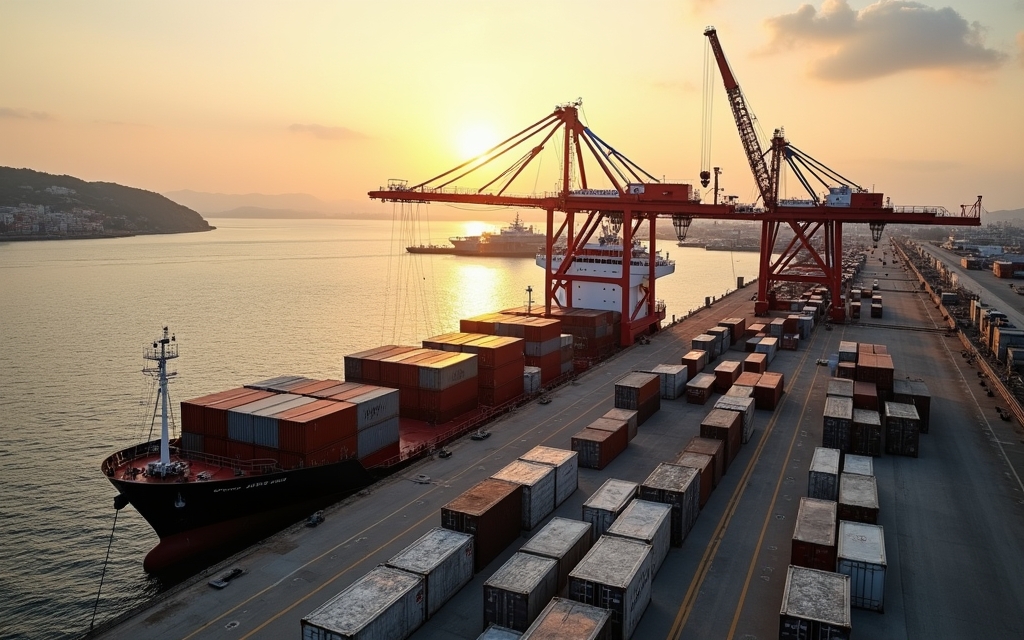
FOB (Free On Board) is the most common pricing term in the international natural stone trade. When a Turkish supplier quotes you FOB Izmir or FOB Mersin, it means the price covers all costs up to the point where the stone is loaded onto the vessel at the named port. From that moment, risk and cost transfer to the buyer.
Understanding FOB pricing is essential for anyone importing natural stone — whether you are a wholesaler, contractor, or architect. Misunderstanding these terms can lead to unexpected costs that erode your margin significantly.
What Is Included in FOB Pricing?
A FOB price from a Turkish stone supplier typically includes:
- Quarry or factory price — the base cost of the stone material itself
- Processing and finishing — cutting, polishing, honing, tumbling, or sandblasting as specified
- Packaging — fumigated wooden bundles, seaworthy crates, or pallets suitable for ocean transport
- Inland transport — trucking from the factory or quarry to the departure port (Izmir, Mersin, or Istanbul)
- Port handling — terminal charges, customs clearance, and loading onto the vessel
- Export documentation — certificate of origin, commercial invoice, packing list, and bill of lading
When you receive a FOB quote of $28/m² for Classic Travertine, all of the above is included. What is NOT included is ocean freight, insurance, import duties, and inland delivery at your destination — those are your responsibility as the buyer.
FOB vs CIF: Which Is Better?
CIF (Cost, Insurance, Freight) includes everything in FOB plus ocean freight and marine insurance to the destination port. Some buyers prefer CIF because it simplifies logistics, but there are trade-offs:
Advantages of FOB
- Lower total cost — Suppliers often add a margin on freight when quoting CIF. Arranging your own freight typically saves 10-20%
- Control over timing — You choose the shipping line, route, and transit time that suits your project schedule
- Transparent pricing — You see the true stone cost separate from logistics, making it easier to compare supplier quotes
- Flexibility — Combine shipments from multiple suppliers into one container for cost efficiency
When CIF makes sense
- First-time importers who want a simpler, all-in price
- Small orders (LCL shipments) where individual freight negotiation has less leverage
- Tight deadlines where the supplier coordinates everything for speed
Calculating Your True Landed Cost
The FOB price is only the starting point. To understand your actual cost per square meter, you must add:
- Ocean freight — $2,500-4,500 per 20ft container from Turkey to US East Coast; $3,000-5,500 to US West Coast; $1,800-3,000 to Middle East
- Marine insurance — typically 0.3-0.5% of the cargo value
- Import duties — varies by country and stone type (US: 3-6% for marble, 0-3% for travertine; EU: 0-4%; GCC: 5%)
- Port and handling charges — $300-800 per container at destination
- Inland delivery — from destination port to your warehouse or job site
- Customs brokerage — $150-400 per shipment
Example: FOB to Landed Cost Calculation
Let us calculate the true cost of importing a 20ft container of Classic Travertine to New York:
- FOB price: $28/m² x 800m² (20ft container) = $22,400
- Ocean freight (Izmir to NY): $3,800
- Marine insurance (0.4%): $105
- US import duty (3% on travertine): $672
- Port/destination charges: $550
- Customs brokerage: $250
- Inland delivery (port to warehouse): $800
Total landed cost: $28,577 / 800m² = $35.72/m²
The FOB price of $28/m² becomes $35.72/m² landed — a 28% increase. Knowing this calculation before you order prevents margin surprises.
Key Turkish Export Ports
Turkey exports natural stone primarily through three ports:
- Port of Izmir — The largest marble and travertine export hub, serving quarries in Denizli, Afyon, and Burdur. Closest to the Aegean marble belt
- Port of Mersin — Serves quarries in Central Anatolia and the Mediterranean coast. Primary route for Middle East and Asian markets
- Port of Istanbul (Ambarli) — Handles specialty and high-value stone shipments, particularly for European destinations
When comparing FOB quotes, always check which port is named. FOB Izmir and FOB Mersin may have different inland transport costs built in, depending on where the factory is located.
Negotiating Better FOB Terms
- Volume commitments — Suppliers offer 5-15% discounts for annual volume agreements vs. spot orders
- Payment terms — FOB prices assume 30% advance + 70% against bill of lading. Better terms (50/50 or L/C at sight) may carry a small premium
- Mixed containers — Combining multiple stone types or finishes in one container spreads fixed costs across more product
- Off-peak shipping — FOB prices are stable year-round, but ocean freight drops 15-25% outside the summer peak season
Ready to Import Turkish Stone?
Atlasia Trading provides transparent FOB pricing with full cost breakdowns for all our natural stone products. We ship from both Izmir and Mersin ports, and our export team handles all documentation and port logistics. Contact us for a detailed FOB quote including product specifications, packaging details, and estimated lead times.